The origin story, the shutdown list, and the thirty-year test are in Be Your Own Historian. This post is about the one thing that essay doesn’t cover. What building slowly teaches you.
I have been deliberately capturing my own life since 2010. In 2013 I was wearing a Basis B1 on my wrist for biometrics. I had a Garmin eTrex in my pocket on weekend rides. I was checking in to Foursquare at every coffee shop, then every street corner, then every bench I sat on. RunKeeper was running. Moves was running. Later it was Automatic in the car, Narrative on a clip on my shirt, Limitless on a lanyard around my neck. I was photographing meals before that was a punchline.
I did all of that because I believed the data was worth keeping. I still do.
In 2012 I tried to build the place it could live and failed. In 2014 I went to a coding bootcamp and learned to close the gap myself. In 2016 I started building what became Tractor and Silo, and I have used it every day since.
The graveyard
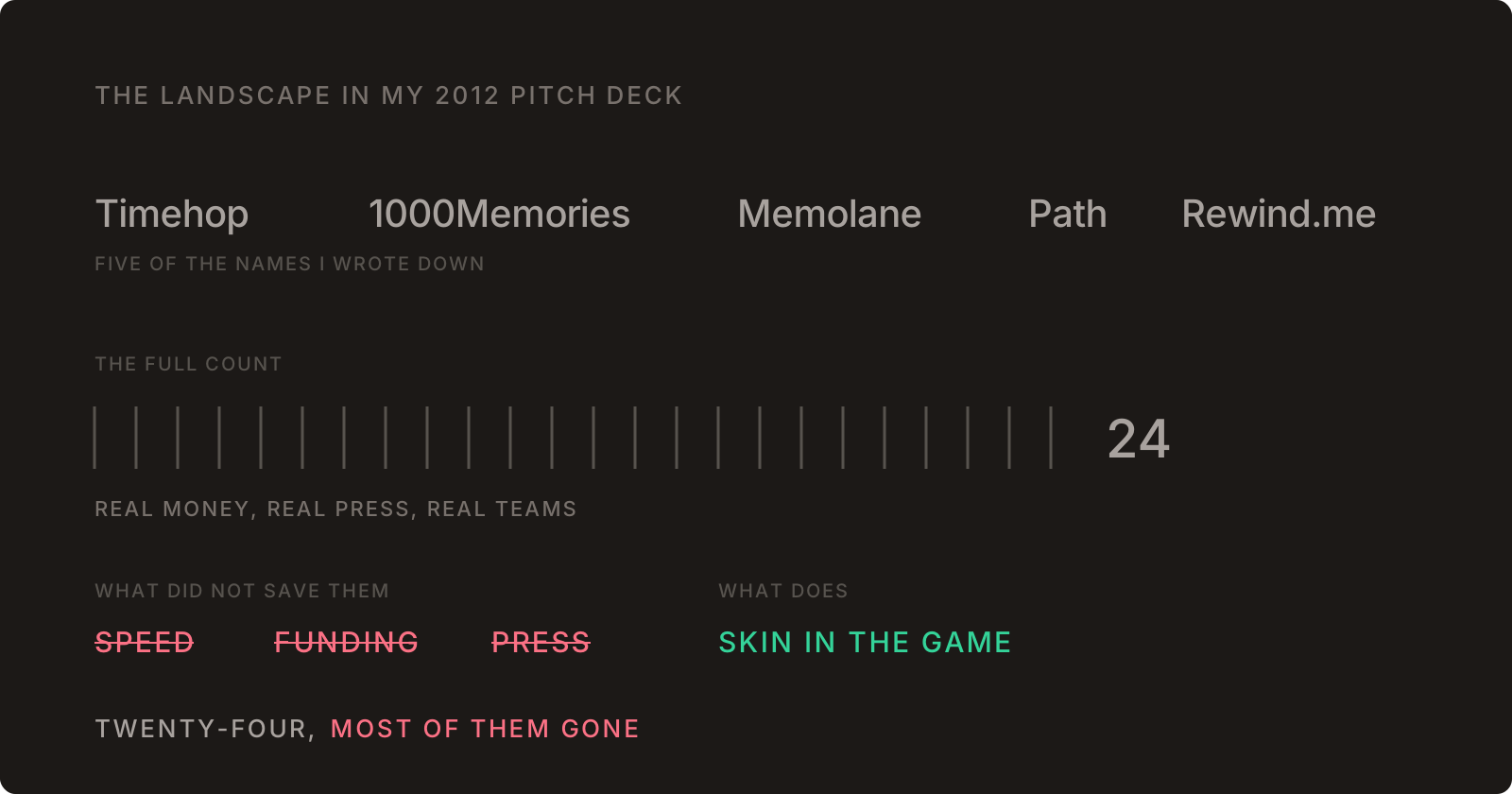
In my original 2012 pitch deck I cataloged the competition. The deck listed twenty-four companies working on similar problems. Timehop, 1000Memories, Memolane, Path, Rewind.me, and nineteen more. Products that raised real money, launched with real press, had real teams.
Most of them are gone.
What I learned from watching that graveyard fill up is practical. Speed didn’t save those companies. Funding didn’t save them. Press didn’t save them. What saves a product is whether someone needs it badly enough to keep it alive, and whether the person building it has enough skin in the game to stay.
I had skin. Capture since 2010, and counting. The platform was going to exist or I was going to keep building it until it did.
What 14 years teaches you that 14 days can’t
There is a lot of noise right now about how fast you can build software. Fourteen days to ship a product. A weekend from idea to launch. AI doing what used to take a team. Fast is real, the tooling is impressive, and I use AI in my own development process every day. I’m not arguing against any of that.
What I learned from the long version is something else.
In 2012 I thought I was building a tracking application. A tool for capturing life events with structured metadata. That framing wasn’t wrong, but it was incomplete in a way I couldn’t see yet.
After ten years of living inside the product I understand something I couldn’t have said at the start. The goal was never the data. The data is the medium. The goal is the journal entry worth keeping. The shape of a Saturday in 2019 you can return to. The record someone might hold in their hands in thirty years and feel something.
That’s what the practice always wanted. I didn’t design it. I noticed it after a decade of doing it.
Tools change what’s possible. They don’t change what’s worth doing. They don’t do the domain work. They don’t give you years of intimate knowledge of your own problem. They don’t tell you what question to ask. The people building apps in fourteen days are doing something real, and speed is a legitimate advantage in a lot of markets.
But for software that asks people to trust it with their memories, their location, their conversations, their family, speed is not the first virtue. Depth is. Very few people build something they still use, improve, and believe in fourteen years later.
The part I get to keep
I think about all of this most when I’m capturing with my kids. I’m the one who pulls out the phone. If they want to, they add a who or a why to what goes into the silo, a small detail I would have missed.
The privilege of building a record like this isn’t only that I get to remember. It’s that I get to live my life twice. Once as it happens and once when I return to it. And the kids will get to see it from the outside. They’ll know who I was on a Tuesday in May of 2026.
The data was always going to be worth keeping. It just took fourteen years to build the place it was supposed to live.