I have 17,637 saved articles, by the count in my April 2026 index. Twenty-two years of reading. In November 2025 I ran the archive through an AI enrichment pipeline and built a dashboard on top, and it showed me patterns I would never have found on my own.
The archive came in two parts. About 7,000 articles from Instapaper, a decade of “read later” that I actually did read, exported to Markdown after a wrestling match with their API. And a legacy collection of 10,000 more, going back to 2004, in every format there is. PDFs from academic journals. Word documents from colleagues. RTF files from who knows where. Raw HTML from the early blog era.
Having 17,000 articles is like having 17,000 books in boxes in the garage. You own them. But can you find the piece about decision-making under uncertainty you read in 2014? Can you see how your interests moved from technical implementation to system design?
Teaching the machine to read
Every article got the same structured extraction. Is this real content or corrupted. Three to five topics. People, organizations, locations, concepts. Sentiment, emotion, and a two or three sentence summary.
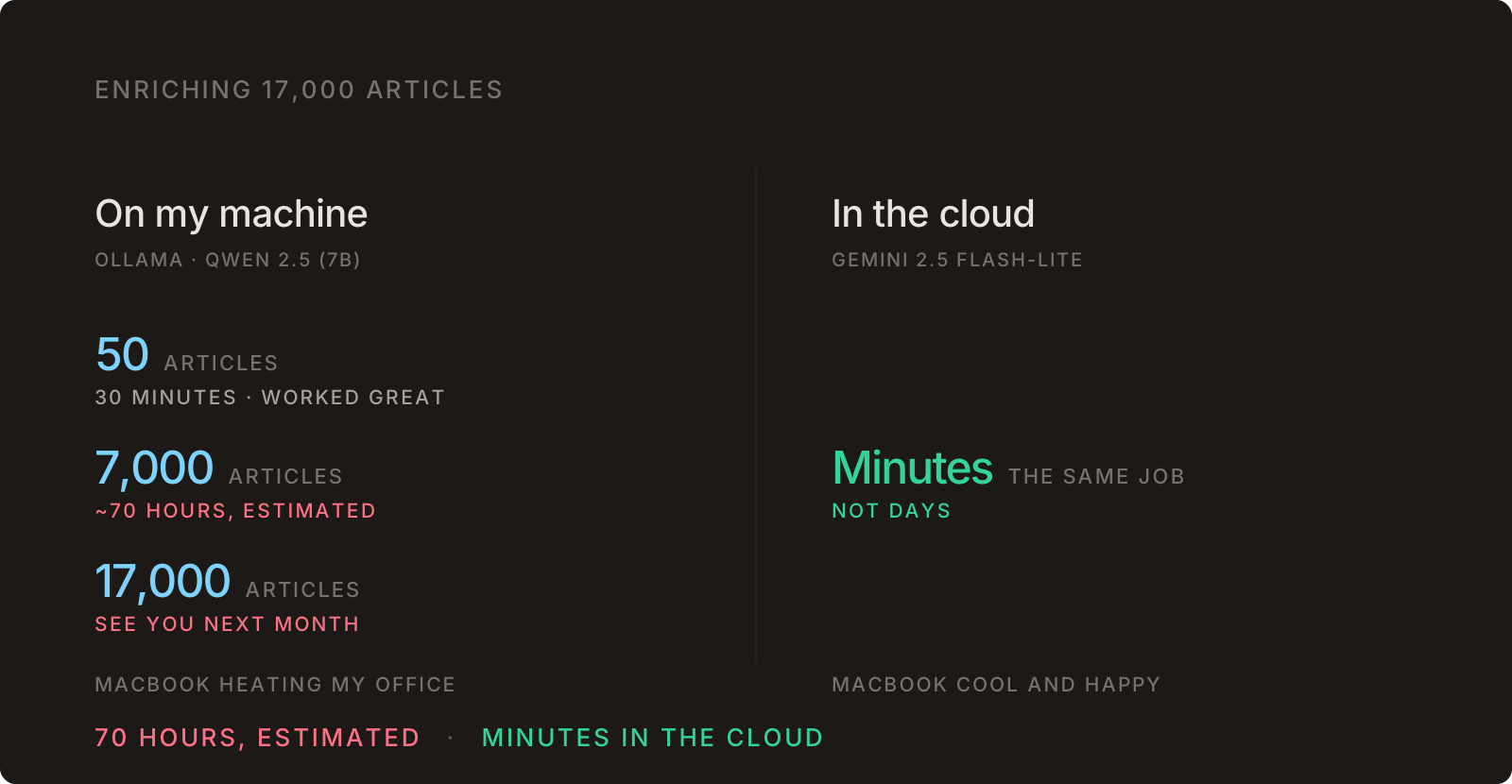
I started local, with Ollama running Qwen 2.5, because the romantic version is that everything runs on my machine and nothing leaves. The arithmetic disagreed. Fifty articles took thirty minutes and worked great. Seven thousand projected to seventy hours with the MacBook heating my office. Seventeen thousand was see you next month. In the cloud, Gemini 2.5 Flash-Lite did the job in minutes.
That verdict has aged. That run was 2025, on a laptop, with a 7B model. The same question asked on a desktop with a newer local model came out the other way. In the inbox bake-off, a 35B mixture-of-experts model turned each message into a structured record in about 3.8 seconds with zero hallucinations, which is exactly this class of job. What killed local in 2025 was throughput, not quality, and throughput is the thing that moved. For frontier work the cloud is still better than anything on my desk, and it isn’t close.
The corruption story
Web scraping fails in fascinating ways. 286 articles from 2012 to 2015 all mentioned “Wrightwood 659.” Some cultural phenomenon I’d missed? No. When Instapaper saved articles from Co.design, it sometimes grabbed the sidebar navigation instead of the article. My carefully curated design archive was 286 copies of the same website menu.
The fix was content validation in the pipeline. If the model says the body doesn’t match the title, flag it. Don’t delete it. Those corrupted files are a record of how web scraping worked in 2013.
What the dashboard showed me
The dashboard is Streamlit. Pure Python, reactive, dark by default, and it runs locally so the data never leaves the machine. Eight views. A few of them told me things I didn’t know.
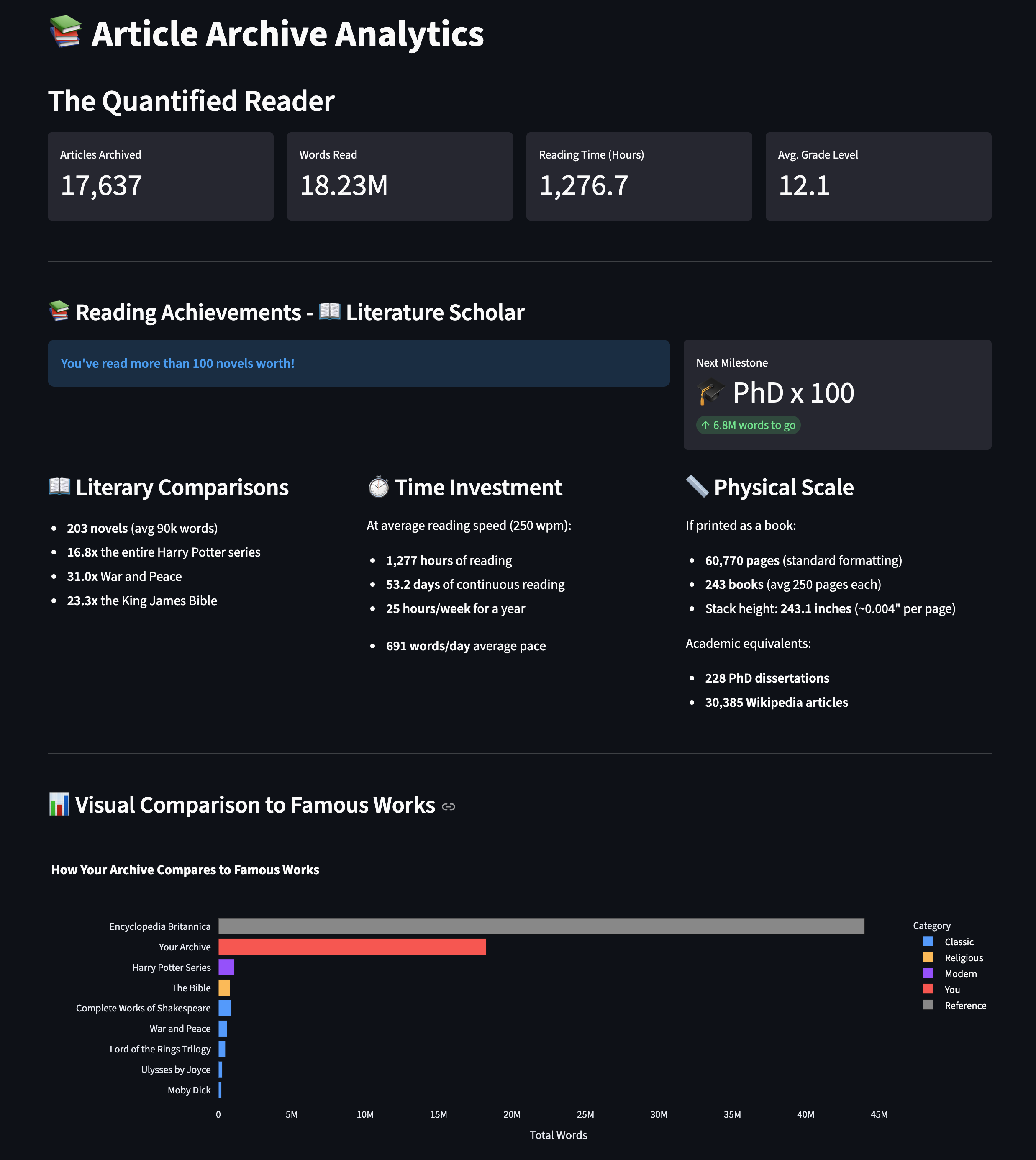
The volume, as of April 2026. 18.23 million words, about 203 novels. 1,277 hours of reading. Average complexity grade 12.1.
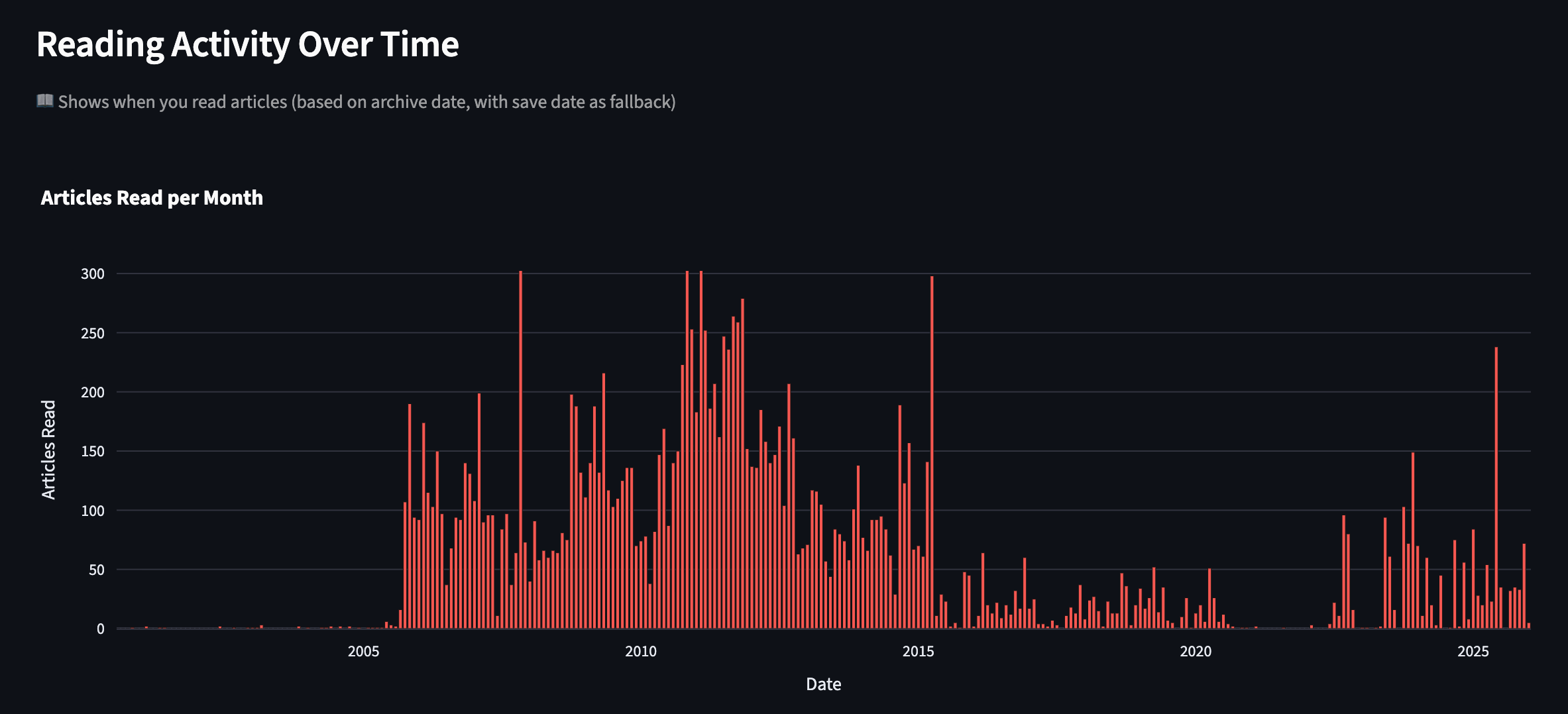
The timeline is a biography I didn’t write. I peaked in 2011 at over 2,700 articles, deep into entrepreneurship and startup culture, reading everything I could get my hands on. Then the bottom fell out. I enrolled in a coding bootcamp, pivoting from finance to engineering, and two sons arrived. By 2016 I was reading one tenth the volume. There’s a resurgence starting in 2022.
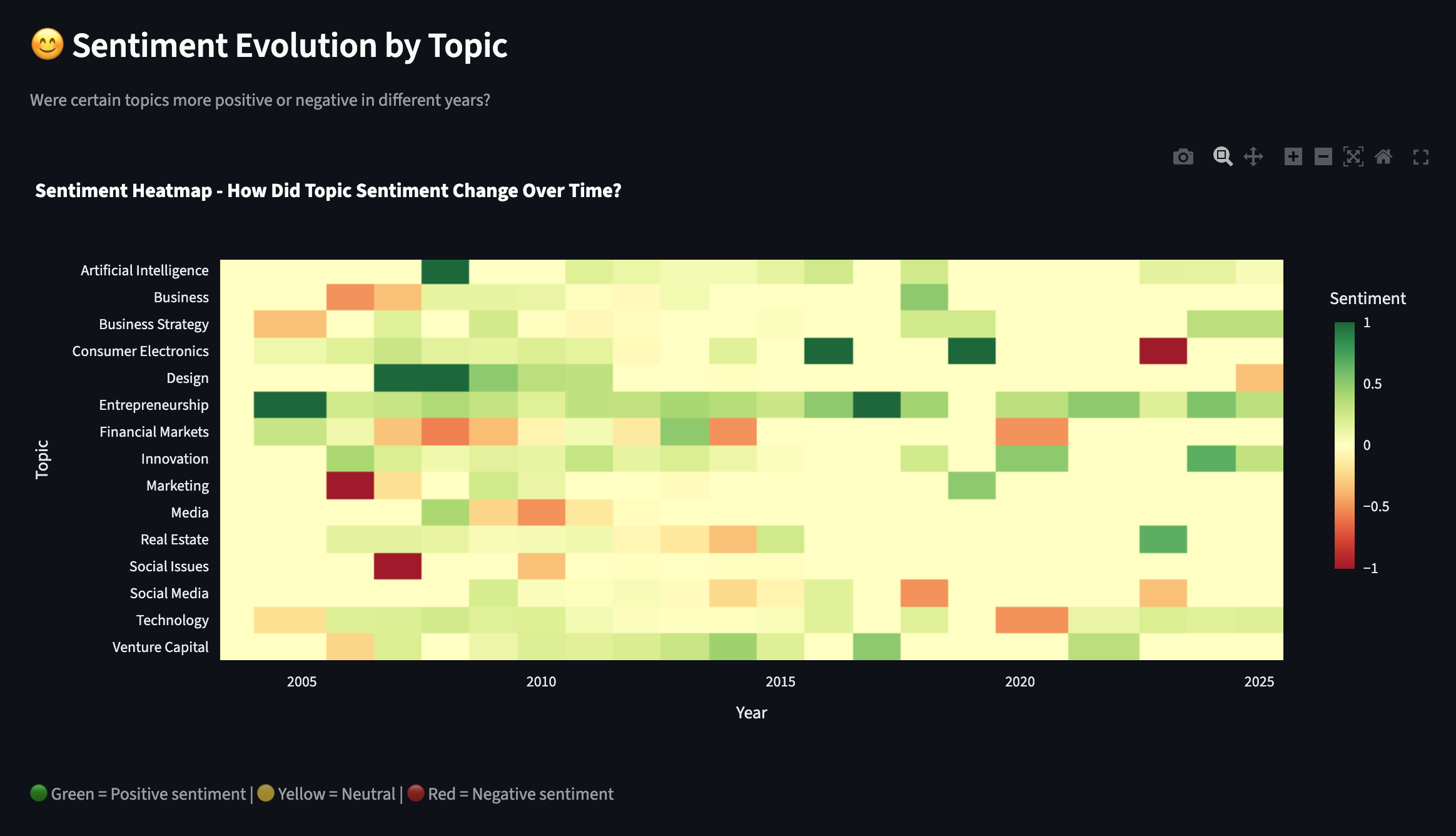
Emotional weather. 2020 stands out. More than a third of the 198 articles I saved that year carry negative sentiment, the year the pandemic upended everything. The heatmap holds smaller stories too. Marketing went negative during the 2008 financial crisis. Social media turned sour around 2018. Each red cell is a small record of a collective mood I was absorbing without noticing.
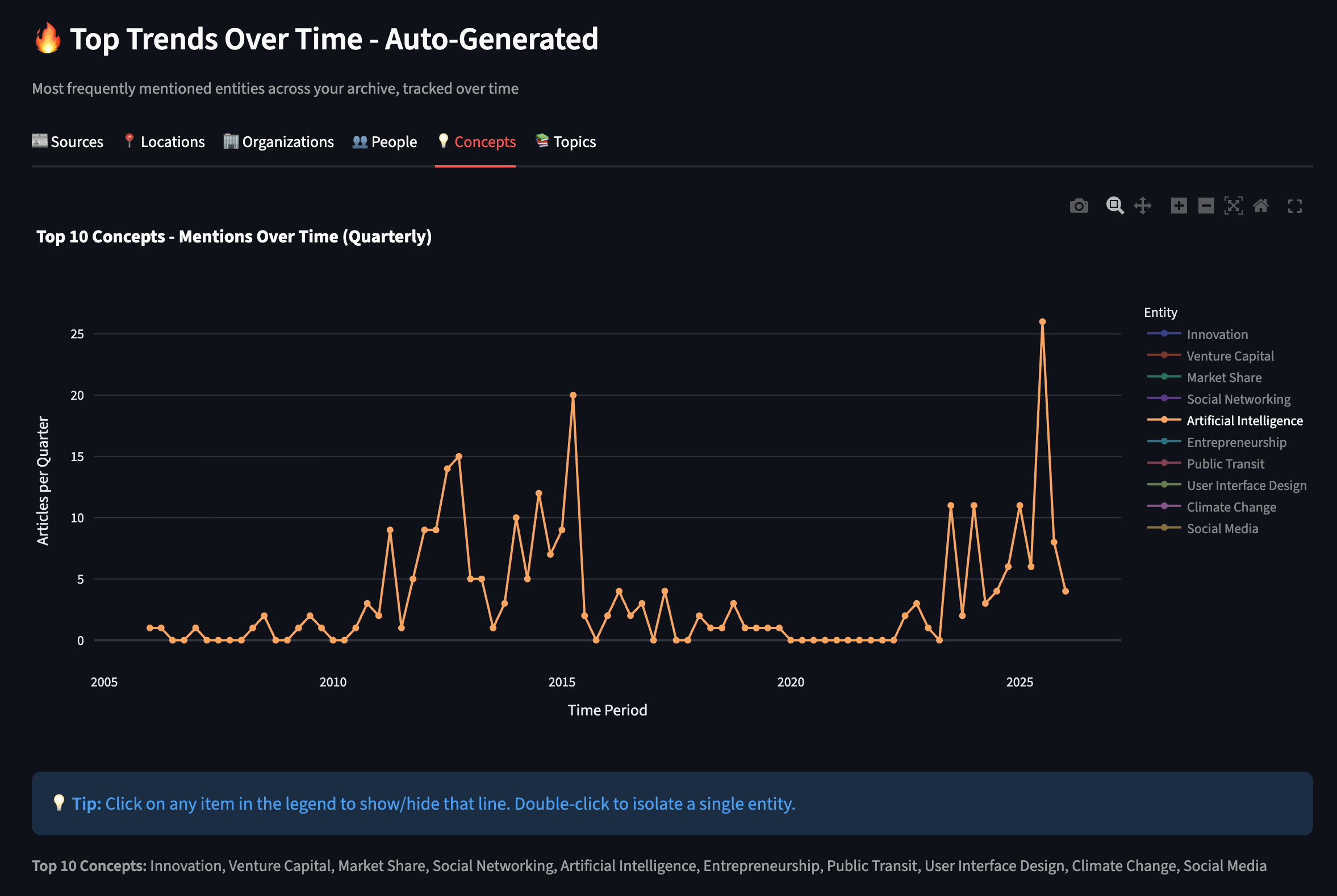
Blockchain peaked in 2017 and vanished. Remote work was a steady hum until 2020 exploded it. Climate change never left. AI was nearly flat from 2005 to 2020 and then went vertical.
Two smaller ones. My reading grade level drifted from about 10.7 in 2010 to just over 12 in the last few years, and I read most on Thursdays. No idea why.
In 1945 Vannevar Bush imagined a desk that kept everything its owner had read, and the trails between items. Mine has twenty-two years in it, with the peak in 2011. Then a bootcamp and two sons, and by 2016 a tenth of the reading.
The reading came back from 2022, the same years AI went vertical in what I saved. I didn’t write any of that down.