I told my partner the other night that I can never turn the Mac Studio off.
There’s a job on that machine at 11:45 at night. One at 3:30 in the morning. One at five, one at seven. Every one of them is an agent. It wakes up, reads something, thinks about it with a model that runs entirely on the chip under my desk, writes something down, and goes back to sleep.
It’s the same M1 Max Mac Studio I wrote about in the spring. Four years old, 64 GB of unified memory, bought long before I knew what I’d end up asking of it. Nothing about the hardware changed. What changed is that I stopped thinking of local models as a toy I poke at and started thinking of the machine as a place where work happens on a schedule, whether or not I’m in the room.
The night shift
Just before midnight, an agent reads back through the whole day, every AI working session, everything that shipped, and writes the day’s record. On Saturdays it writes the week’s.
At 3:30, an agent chews through the day’s captured audio. Nothing fancy, just volume. Detect speech, transcribe, digest, file.
At five, an agent reads all of my email across three inboxes and writes me a morning report. I don’t open my inbox most days. It isn’t 100 percent and I don’t treat it like it is. It’s a really good first pass, and I trust it. That one has a post of its own.
At seven, an agent sweeps every project I maintain, open pull requests, plans that have drifted from reality, stale documents, writes a daily brief, and publishes it to a private status page before I sit down with coffee. I wake up to a desk of briefings. Here’s what arrived, here’s what you did yesterday, here’s what needs you now.
Sunday mornings, one more agent drafts release notes for the week that just ended and leaves them as drafts. It isn’t allowed to publish.
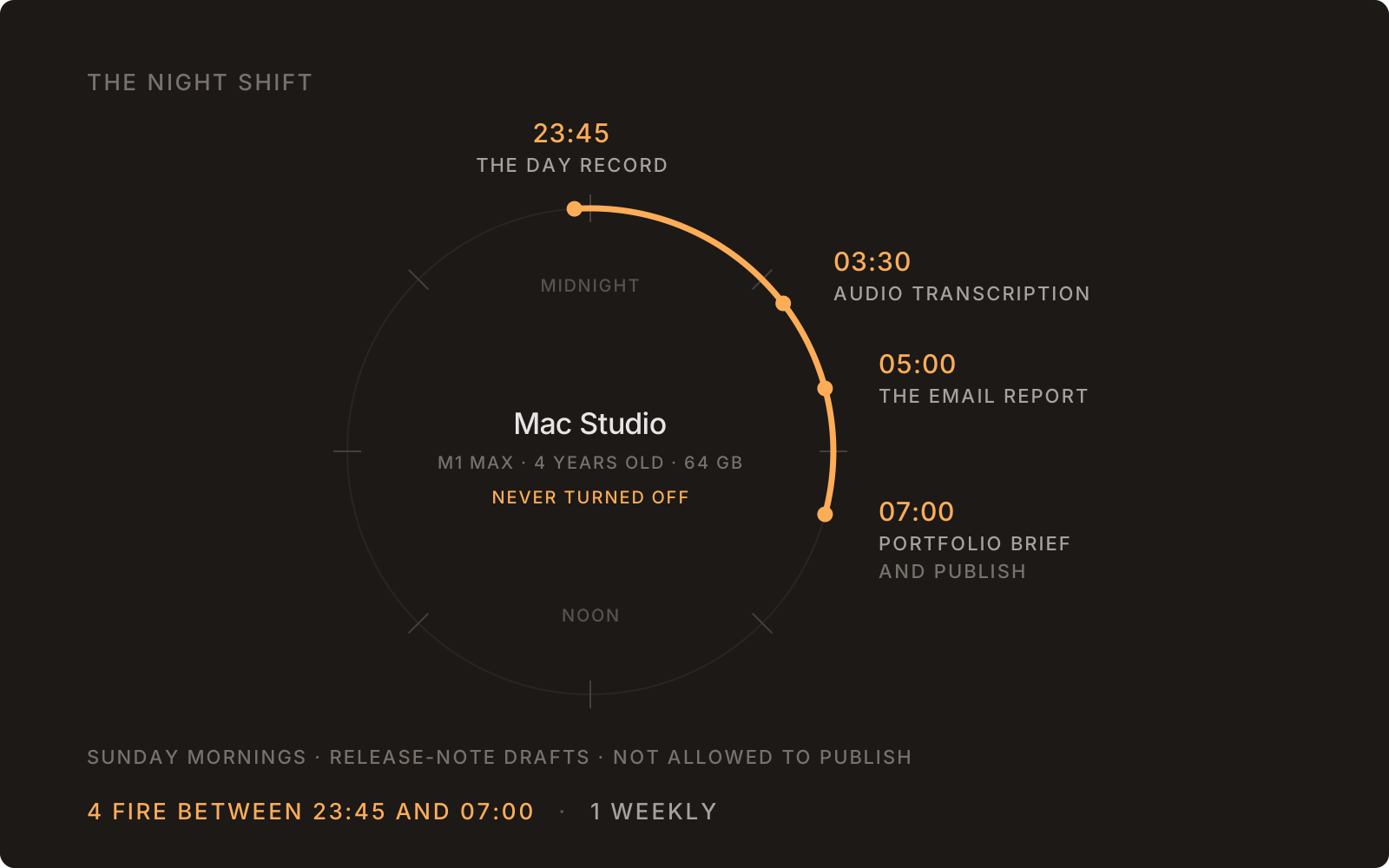
That was the roster in July.
In what sense are these “agents”?
The word is doing a lot of work in the industry right now, so here’s what I mean by it.
Each of these jobs is four things. A trigger, which is a schedule. Context, a corpus it reads at wake-up: the mail index, the git history, the day’s transcripts. Tools: scripts, a local inference server, version control. And a deliverable: a report, a record, a set of drafts, a published page. That’s it.
The runtime is launchd.
The brains are open-weight models. A 35-billion-parameter mixture-of-experts model that runs comfortably in that 64 GB.
The memory is git. A run that did nothing leaves no commit. A run that did something leaves a diff that is the report.
The economics I’m testing
Here’s the thesis. Frontier models for the building, local models for the ancillary.
When I’m designing something, working through a hard refactor, or asking for judgment I intend to act on, I use frontier models and pay for the privilege. That work deserves the best available intelligence, and the local-only pose costs people credibility for a reason. The fleet’s work is different in kind. Tightly bound tasks at volume. Classify this message, transcribe this audio, summarize this day. The same operation thousands of times, on private material, where nobody is waiting on the answer.
For that work the marginal cost is electricity, and my email and my family’s records never leave the house. One recent job made about seven hundred model calls in an evening to clean a messy old dataset row by row. On a metered API that’s a bill and a decision. On the Studio it was a fan spinning.
This is a thesis being tested, not a position I’m claiming. The frontier keeps moving, the pricing keeps changing, and I still route plenty of overnight work to cloud models when quality demands it. But the floor, what a machine you already own can do well, has been rising, and every month more of my workload lives on it. I’m reporting the direction of the drift, from my own desk.
The part that unsettles me
I didn’t write these agents. I described them.
I know what I called each job and what I wanted it to do, and an AI wrote the schedules, the scripts, the permissions plumbing, the lock file, the logging. I finally wrote the document that anatomizes every job on the machine.
Non-technical people can be technical now. The interesting work has moved from writing the code to knowing precisely what you want, and being able to say it.
I can’t turn it off.