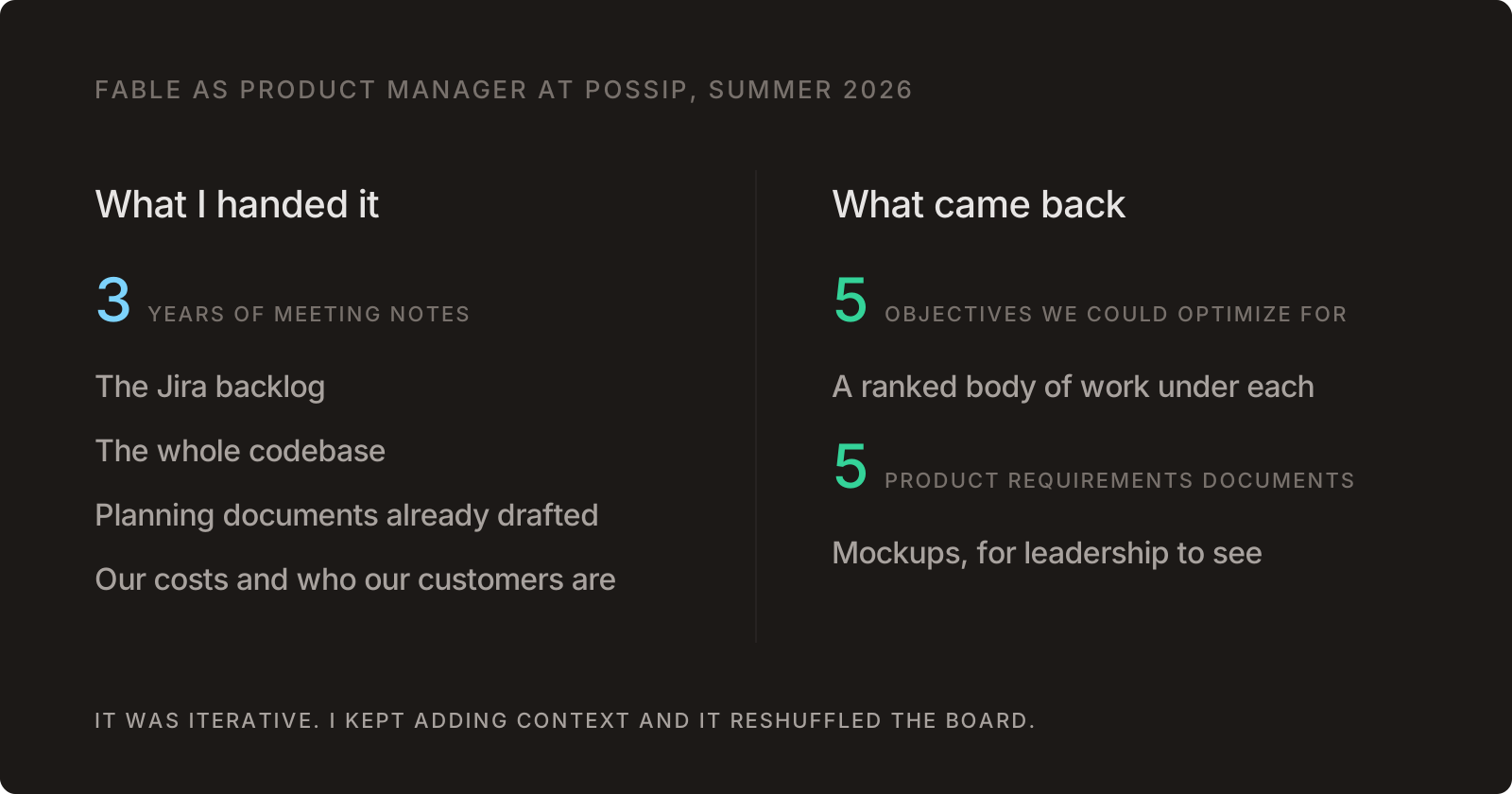
This summer at Possip I handed Fable, a Claude model, three years of meeting notes, the Jira backlog, the whole codebase, and what I know about our customers and our costs. I asked it to act as the product manager and tell me what we should build next. It came back with five things we could be optimizing for, a ranked body of work under each, and then product requirements documents and mockups, because I know senior leadership wants to see something, not read a PRD. It was iterative. I kept saying, oh, I forgot to mention this, and it reshuffled the board. It never lost the thread.
I’ve been calling what I do “outcome engineering” since February. I write the spec and I ship the spec, in the same session, in the same head. There’s no handoff.
The handoff is the artifact that disappeared
For most of the history of software, the spec was a document that crossed a boundary. The person who wrote it was almost never the person who built it. The build was a translation, sometimes faithful, sometimes lossy, always slower than the intent. We built whole disciplines around that boundary.
That boundary is optional now.
When one person can open a session, say what they want in plain language, watch it become a real diff against a real codebase, iterate against tests and against feel, and ship, the spec and the ship are the same artifact. There’s the question, what are we building and why, and there’s the build, alternating turn by turn until the thing is real.
Productivity improvements make the old roles faster. This makes one of the old roles redundant, and the role isn’t product manager. It’s the handoff.
What it looks like from inside
At Possip I’m the only technical person. I sit in the product meeting, I hear the ask, and I’m the one who ships it. Nobody hands me a spec. I write it, and then I’m the person it goes to.
The leverage isn’t typing faster. It’s never losing the meaning between the intent and the implementation, because there’s no handoff to lose it in.
The seat problem
I know people in this seat at good companies whose job description still ends with “writes detailed specs that engineers implement.” Put them in the product seat and you’re asking them to stop shipping. Put them in the engineering seat and you’re asking them to stop thinking about the customer at the depth they’ve already learned to think. Either way you’ve got someone who’ll be unhappy in a year.
I don’t have hiring advice, and I’m not going to pretend to know what the seat pays. I know what it feels like from inside it. That’s how I did it myself for a long time, on nights and weekends, before the day job caught up to what I was doing at home.
I like both halves of the job now. Figuring out what to build, and then watching it get built.